

'/%3E%3C/svg%3E)

To know what to read, what to check, and in what order to move forward if you’re considering leaving for several months in Asia.
The blog already covers budget, apps, places, the checklist, taxation and the realities of life on the ground. Here, those resources are simply put back in the right order.
The goal: to help you move from a still-vague desire to a concrete preparation, without opening forty tabs or getting lost in the details.
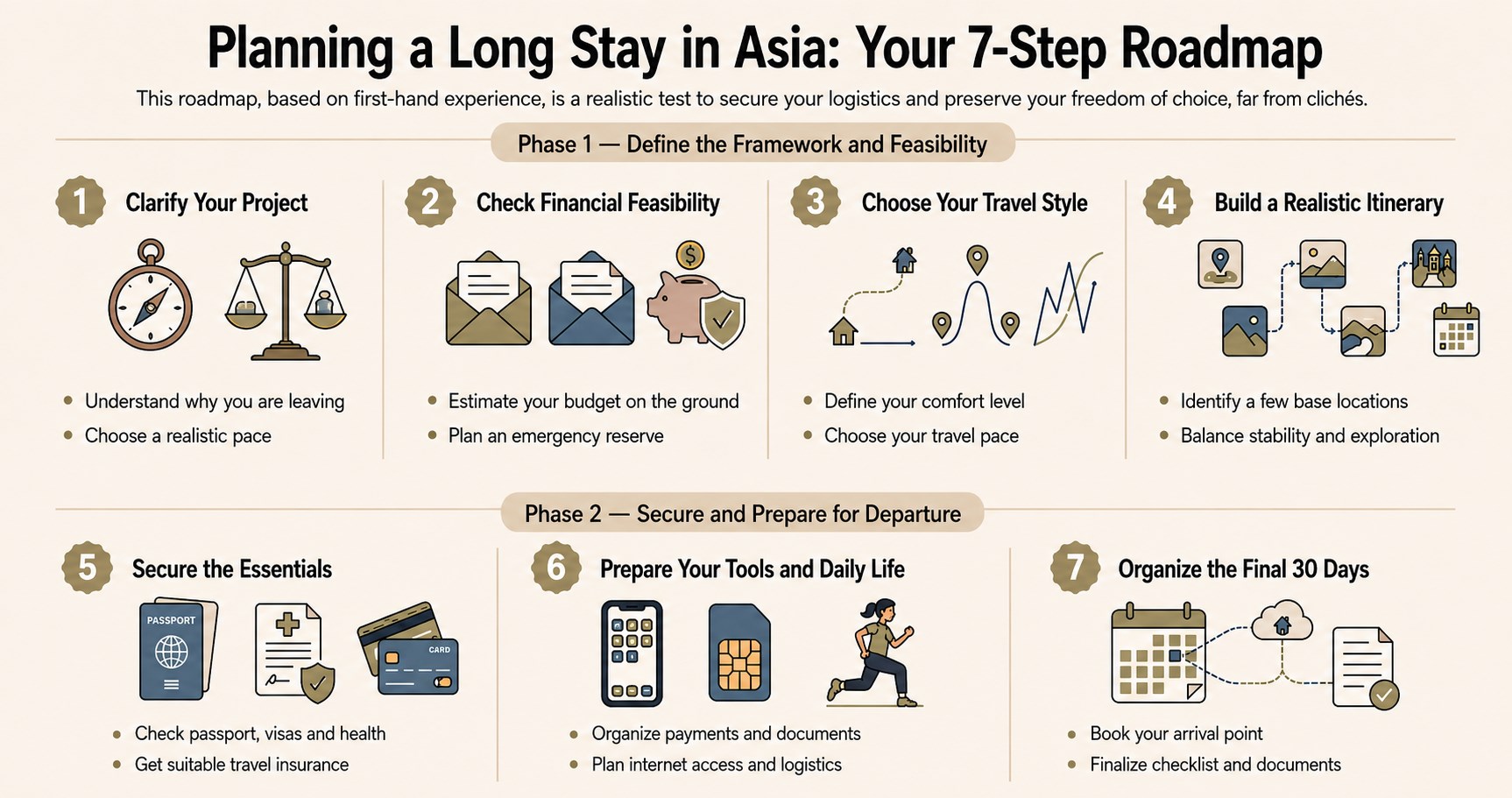
Pick a step on the image to jump straight to its section.
PHASE 1
Define the framework and feasibility
Before booking anything, four decisions give the project a realistic shape: why you’re leaving, with what resources, at what pace, and towards which places.
01Clarify your project
Before comparing countries, visas or budgets, start by clarifying what you’re actually looking for.
Do you want a break, to test a different lifestyle, to travel slowly, to explore several regions, or to see whether Asia could become a more lasting base? You don’t need a definitive project — but you do need to understand why you’re leaving, how long you plan to stay, and what pace might suit you.
02Check financial feasibility
Your budget doesn’t only depend on the country you choose. It also varies with the comfort you’re after, how often you move, housing, social life, and how long you stay in each place. Start by separating:
- the costs needed before departure;
- your day-to-day living budget on the ground;
- the reserve you’ll keep for unexpected situations.
This step tells you how long you can really go for, instead of building your project on a vague estimate.
Real budget for Southeast Asia
TOOL
How much would you actually need to leave?
Test several scenarios based on duration, travel pace, comfort level and number of travellers.
03Choose your travel pace
A slow stay, with several weeks in each place, doesn’t require the same budget or the same energy as an itinerary where you keep changing city or country. You can consider three broad paces:
- slow nomad, with relatively long bases;
- semi-itinerant, balancing settling in and moving around;
- active discovery, with more places and more transport.
The goal isn’t to pick a label, but to avoid an itinerary that doesn’t match your budget, your energy, or your need for stability.
04Build a realistic itinerary
A good itinerary isn’t about stacking up as many destinations as possible. It needs to account for seasons, travel time, transport costs, and your need to find some form of daily routine.
Pick a few possible bases, then leave room to adjust. Some places are useful for an easy arrival, others for slowing down, reconnecting with nature, or testing a simpler life.
PHASE 2
Secure and prepare for departure
Once the framework holds, three steps turn the project into concrete actions: securing what matters, preparing daily life, and organizing the final month.
05Secure the essentials
Passport, visas, health insurance, payment methods and access to your important documents all need checking before departure.
The goal isn’t to settle every formality for the next six months right now. It’s to secure whatever could block you, put you in a difficult position, or force you to change your plans abruptly. If your trip is part of a bigger transition, the question of tax residency may also come up.
Checklist before leaving for 6 months in Asia
Tax residency: the 6-month rule
06Prepare your tools and daily life
A long stay also plays out in small everyday frictions: paying, getting around, accessing the internet, translating, finding an address, or showing a document.
It’s not about installing fifty apps, but about preparing a few reliable tools for payments, transport, navigation, internet access, document backup and translation.
07Organize the final 30 days
The last month is when the project turns into simple actions. It’s time to:
- finalize your documents and back them up;
- check your bank cards and important access;
- book transport and your first accommodation;
- prepare a suitable bag and a fallback plan.
You don’t need to book the whole stay. A few nights on arrival are usually enough to start without pressure and observe the reality of a place before committing further.
GO FURTHER
Three resources, depending on what you need next
THE FULL PICTURE
6 months in Asia: the complete guide
To go deeper into the general framework, the constraints, and the daily reality of a long stay.
THE NUMBERS
Real budget for Southeast Asia
To understand the expenses more precisely, the gaps between places, and the choices that affect your budget.
THE PRACTICAL SIDE
Checklist before leaving for 6 months
To move from reflection to concrete, detailed preparation.
FREQUENT QUESTIONS
The doubts that come back before a long stay
How do I know if a long stay in Asia is realistically an option for me?
Start by looking at three things: your motivations, your personal constraints, and above all your genuine desire to live this kind of daily life. That desire matters a lot, because it isn’t only the destination that shapes the quality of the stay — it’s also how you experience ordinary days, quieter moments, unexpected events, and sometimes solitude. The goal isn’t to plan everything, but to work out whether this lifestyle deserves to be tested in your situation.
What monthly budget should I plan for without putting myself in a difficult position?
For a single adult, the calculator lets you explore scenarios roughly between 800 and 1,600 € per month, depending on pace and comfort level. Over the course of my own stay, my average was closer to 1,000 € per month, with variations generally between 900 and 1,100 € depending on the place and the period. On top of that, you also need to plan separately for flights, insurance, initial equipment, and a safety reserve.
How do I calculate the money actually available for the trip?
Don’t simply divide your entire savings by the number of months planned. Start by subtracting departure costs: transport, insurance, equipment, formalities, and first bookings. Then set aside a reserve for unexpected events or an early return. What’s left is your real living budget on the ground — and the calculator then lets you test several durations, paces and comfort levels.
Is it better to travel slowly or change destinations often?
Travelling slowly generally costs less and reduces logistical fatigue. By staying several weeks in the same place, you can negotiate accommodation better, settle into habits, and limit transport. Changing often means more discoveries, but also more expenses and more time spent organizing. There’s no ideal pace for everyone: the right choice depends on your budget, your energy, and what you’re actually looking for.
What formalities absolutely need to be secured before departure?
The priorities are your passport, visas for the first countries, health insurance, payment methods, and access to your important documents. Plan for several bank cards kept separately, and a digital copy of your documents. You don’t need to sort out every detail of several months of travel — but whatever could block you needs to be secured before you leave.
Do I need to book all my accommodation before leaving?
No. Booking only the first few nights lets you arrive with peace of mind while keeping the freedom to check the neighbourhood, the noise, the internet connection, and the real feel of the place. Once on the ground, it’s usually easier to compare and negotiate a longer stay. Advance bookings remain useful for a late arrival, a very busy period, or a destination where availability is limited.