
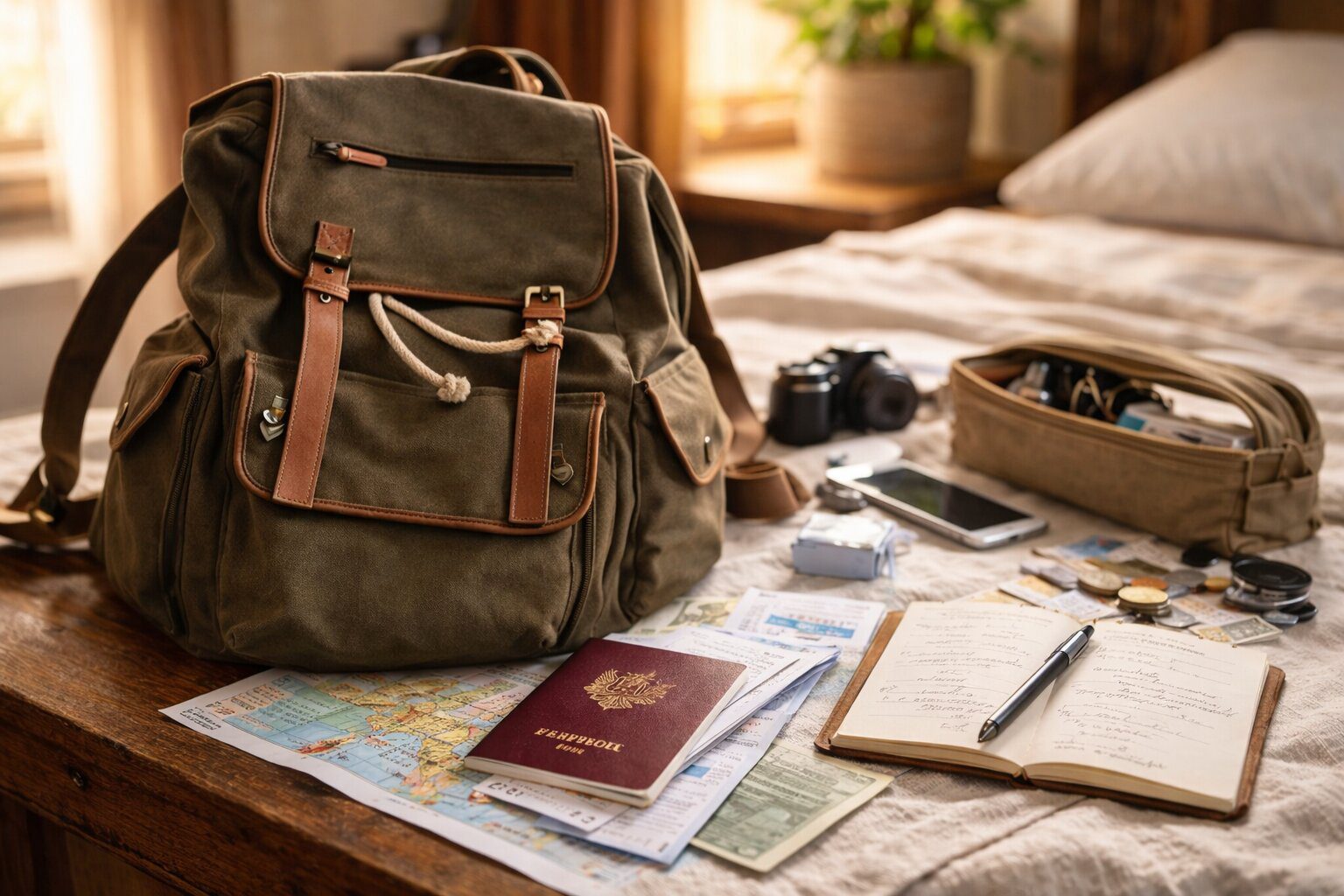
Useful preparation, without trying to plan for everything.
Leaving for 6 months in Asia doesn’t require perfect preparation.
But some things, if poorly anticipated, can needlessly complicate the start of the trip — not dramatically, just from a lack of foresight on concrete points.
This list brings together what actually helped me before leaving.
You can read it quickly to check the essentials, or use it as a basis to prepare your departure step by step.
CHECKLIST
The essentials at a glance
Every line is clickable and leads straight to the point to check.
- 01Passport and documentsValidity, visa, All Indonesia and backed-up copies See the section →
- 02Budget and cards€800 to €1,500 a month depending on the country, several payment methods See the section →
- 03Health insuranceCoverage abroad, duration and repatriation See the section →
- 04First accommodationTwo to three nights booked on arrival See the section →
- 05InternetLocal SIM or eSIM for the first few days See the section →
- 06HealthTreatments and a small basic kit See the section →
- 07LuggageBring what genuinely gets used See the section →
01Documents and paperwork
This is rarely what people forget. But it’s what most easily causes problems if poorly anticipated.
Before you leave
- Passport valid for at least six months after your planned return date
- Plane ticket — a one-way ticket is possible depending on the country, but entry requirements and proof of onward travel are worth checking
- Visa requirements known and prepared
- For Indonesia, the All Indonesia arrival declaration to be filled in online within the 72 hours before landing
To back up
- Digital copies of all important documents: passport, tickets and insurance
- Cloud storage accessible from any device: Google Drive or email
- One copy downloaded and accessible offline
It’s not complicated. But it’s exactly the kind of point you sort out quickly, and it avoids a real hold-up on arrival.
02Money and payments
The problem isn’t paying. It’s no longer being able to pay.
One blocked card, one declined withdrawal, one limit reached — it creates an uncomfortable situation in a foreign country. Not dramatic, but avoidable.
What works for me
| Card type | Use |
|---|---|
| Wise | Everyday payments, withdrawals and fast international transfers — essential for me |
| Revolut | Alternative or complement to Wise |
| Regular bank | Backup in case the other two get blocked |
Before you leave
- Check the expiry date, the limits, the fees and that payments abroad are enabled
- Tell your bank you’re leaving if it recommends it, to avoid an automatic block
- Keep the card-cancellation numbers somewhere separate from the cards
To carry on you: a minimum of €200 in cash, for the first few days or unforeseen situations.
Three cards is the right level. Two is the minimum.
PRACTICAL TOOL
Test your starting budget
The calculator separates departure costs, life on the ground and the safety reserve.
03Health insurance
A single hospital stay can cost several thousand euros in Asia. This is a point worth securing, even if you hope you’ll never need it.
What to check
| Question | What you need to know |
|---|---|
| Does your current insurance cover you abroad? | Often limited to three months, sometimes up to a year depending on the contract |
| Is repatriation included? | Essential |
| Does the duration match your plans? | To check against the full six months |
| Are the limits and exclusions suitable? | Worth reading before choosing on price alone |
If it doesn’t:
- Specific travel insurance, such as Chapka or AVI International
- Or expat insurance if the project runs longer
This isn’t optional. It’s one of the few points where saving money isn’t worth the risk.
04Accommodation on arrival
You don’t need to plan everything. You need to know where you’ll sleep for the first few days.
What works
- Book two to three nights maximum somewhere simple and well located
- Then try it out, observe, and extend or change based on how it feels once you’re there
What doesn’t work
- Booking a full month without knowing the neighbourhood or the atmosphere
- Spending hours looking for the “perfect” place before you’ve even arrived
The best method remains: arrive → try it out → adjust. On the ground, decisions are much sounder.
05Internet and communication
Internet is rarely a problem in Asia. But the first days without a connection are uncomfortable — especially for getting your bearings, staying in touch, and accessing documents.
The options
| Solution | Detail |
|---|---|
| Local SIM | About €5 to €15 a month depending on the country — buy at the airport or in town |
| eSIM | Set up before you leave — handy for being connected as soon as you land |
Prerequisite: an unlocked phone, compatible with a local SIM or an eSIM.
Before landing, I also download the address of the first accommodation, a map of the area and the important documents prepared in step 1 →
Nothing complicated. A local SIM within the first few hours, and the problem is solved.
06Health — the useful minimum
Pharmacies in Asia are generally well stocked. Doctors are accessible and often cheaper than in Europe. This isn’t the place to overload your luggage.
Worth bringing
- Essential or prescription medication
- The prescription and the international name of any essential treatment
- A small basic kit: painkillers, digestive medication and bandages
Can wait until you’re there
- Pretty much everything else
The idea isn’t to plan for everything. It’s to not leave with nothing at all.
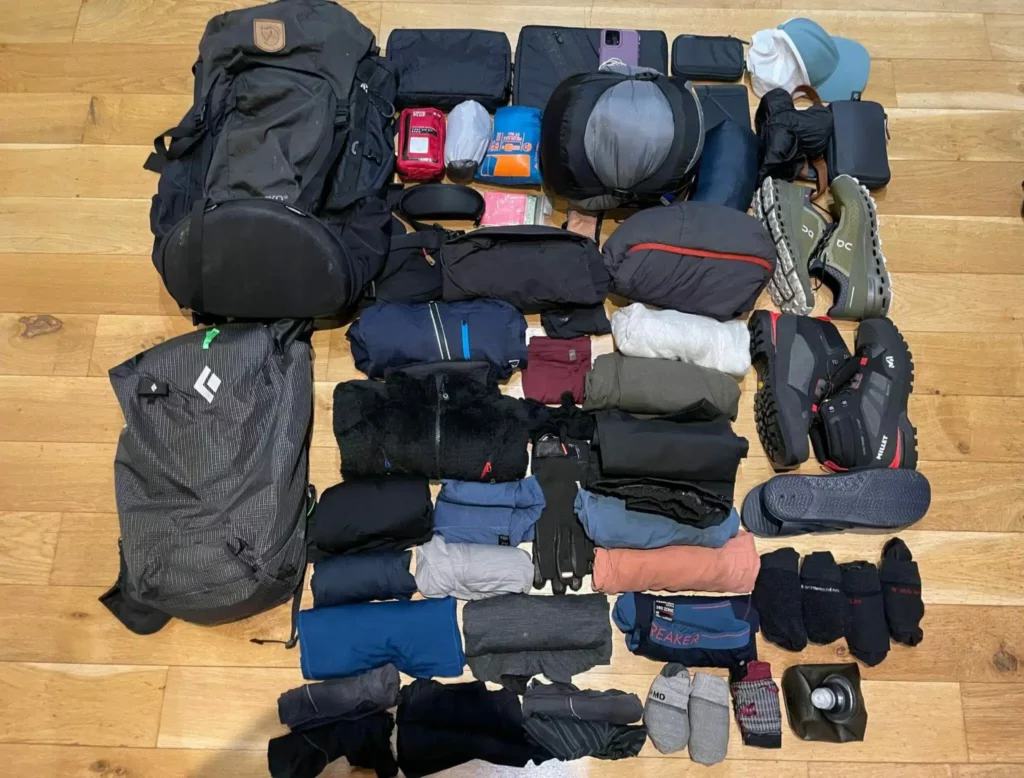
07Luggage — the right level
The temptation is to bring everything “just in case”. That’s almost always a mistake.
What really matters
- Light clothing, suited to the heat, easy to wash
- What you actually use every day
- Versatile items rather than several solutions for the same need
What you’ll discover once there
- That almost everything can be bought in Asia, often cheaper and better suited to the climate
The best test: do I use this every week? If not, it stays in France.
FINAL STRETCH
What people most often forget
Not complicated things. Just the ones that get put off because they seem obvious — and so end up handled last, sometimes too late.
- Tell your bank you’re leavingBefore departureBack to point 2 →
- Back up your documentsThe week beforeBack to point 1 →
- Check your insuranceAt least two weeks beforeBack to point 3 →
- Book the first few nightsBefore landingBack to point 4 →
Twenty minutes is enough to sort it all out. The problem is remembering to do it.
LEAVE ASIDE
What’s a waste of time
Planning everything in detail. Organising all six months in advance. Trying to anticipate every possible situation.
That level of preparation gives an impression of control. In reality, it mostly creates rigidity — and inevitable disappointment when things don’t go as planned, which they never do.
The goal isn’t to control everything. It’s to plan for the start so the rest can build itself once you’re there.
Conclusion
This checklist doesn’t guarantee everything will go smoothly.
It avoids the simple mistakes — the ones that needlessly complicate the first few days, and that could have been sorted out beforehand in a few hours.
The rest happens once you’re there. Gradually. With adjustments no one can plan for from France.

Leave a Reply