
When you travel for a long time in Southeast Asia, some experiences
go far beyond what you’d imagined at the start. The Pasola, on the island of Sumba in Indonesia — an island located an hour’s flight from Bali, but twice as large and a hundred times less touristy —
clearly belongs in that category.
On March 9, 2026, I witnessed one of these ritual battles near the traditional village of Ratenggaro, in the Southwest Sumba region. What I saw had nothing of a tourist show organized for visitors. It was a living, intense tradition, deeply rooted in local culture.
If you’re considering an extended trip to the region, I explain how to organize this kind of adventure in my guide:
➡️ 6 Months in Asia: the complete guide 2026
But before trying to explain what the Pasola is, I’ll simply describe what I observed.
Arriving in Ratenggaro to watch the Pasola
My base for the day was Tambolaka, a small town about 1 hour 15 minutes by scooter from the site.
The route crosses hilly countryside, then eventually meets the coast. You arrive near the traditional village of Kampung Adat Ratenggaro, one of the most impressive villages in Sumba.
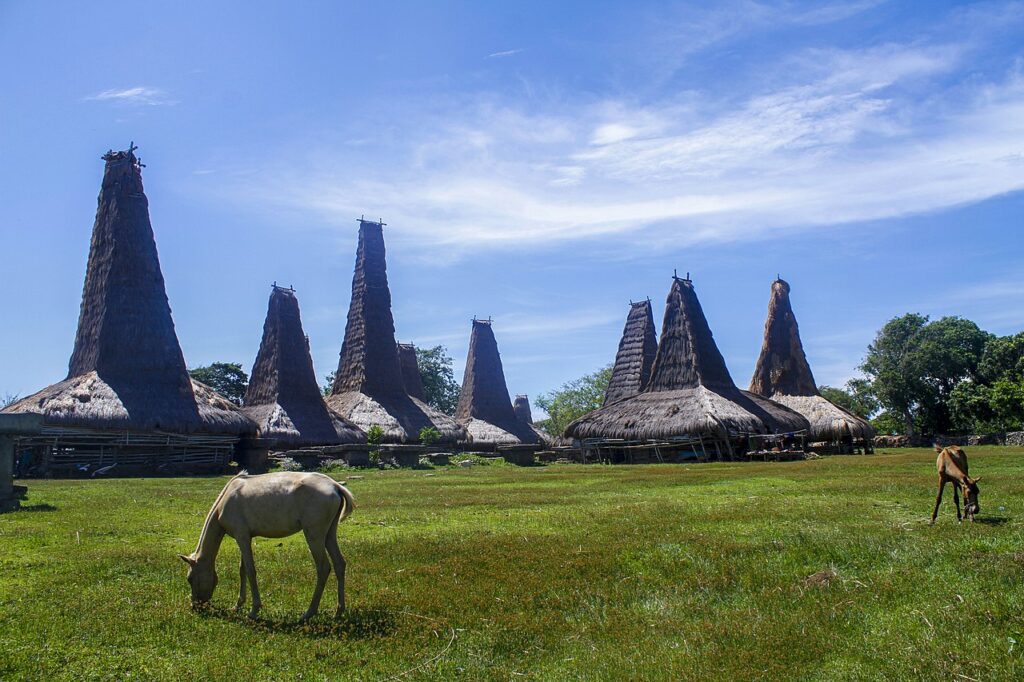
The village stands out for its traditional houses with very tall roofs, once made of thatch and natural grasses. In many parts of the island, these roofs have been replaced with corrugated metal, even though the spectacular shape of the houses has been kept.
In Ratenggaro, most houses have kept their traditional roofs made of natural materials, giving the village a particularly authentic atmosphere.
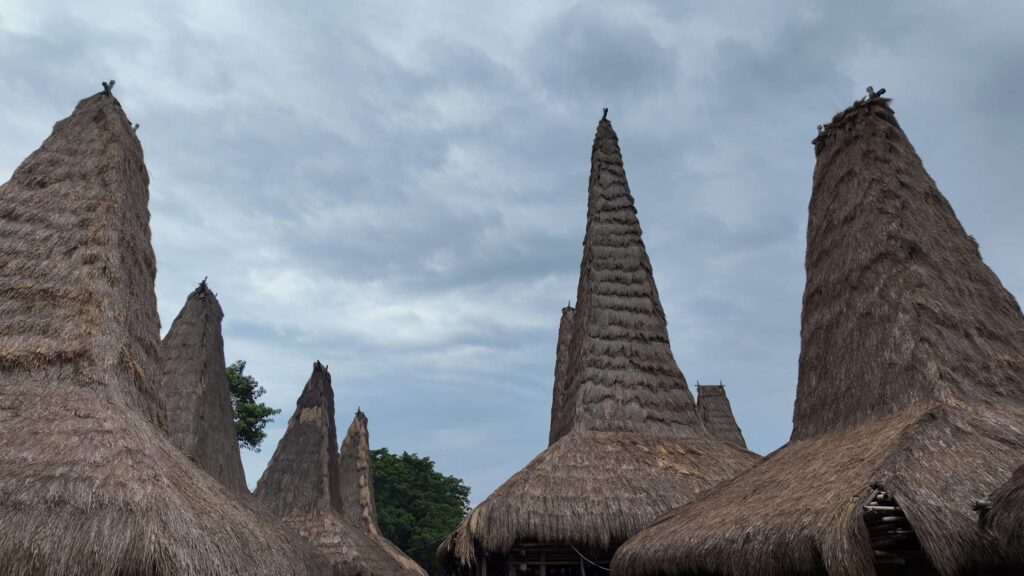
In front of some houses, you can also see large funerary megaliths, evidence of an ancient culture where ancestors hold a central place.
But Ratenggaro isn’t just about its architecture.
The village sits within a spectacular landscape where tradition, nature, and ritual meet.
The spectacular setting of the Pasola in Sumba
What makes this Pasola even more impressive is where it takes place.
A few hundred meters from the village, the landscape opens onto an immense wild beach. The Waiha River, about 19 kilometers long, winds through the plain before reaching the Indian Ocean.
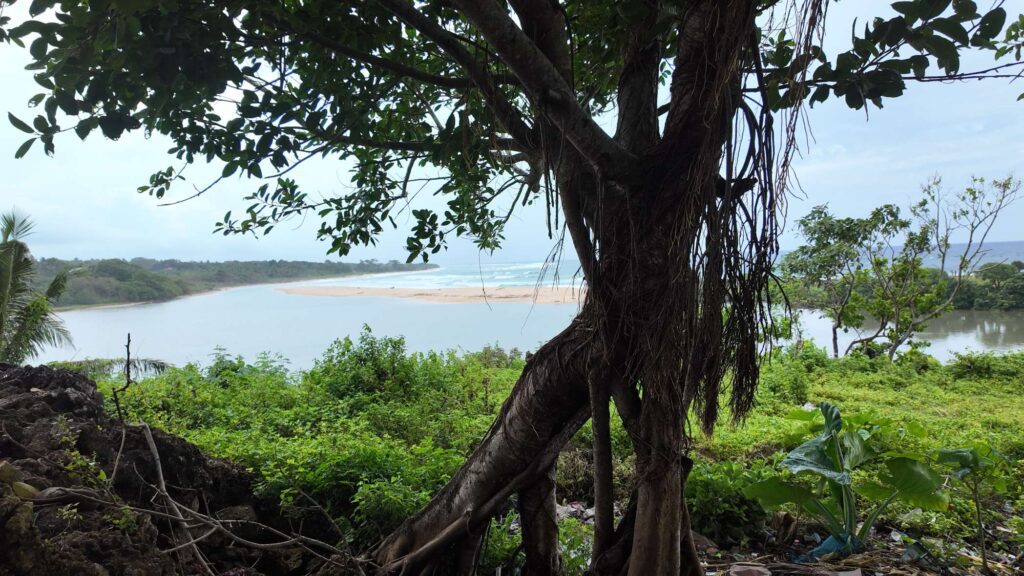
At its mouth, the river mixes with the sea in a very particular landscape, somewhere between sand, fresh water, and powerful waves.
Crocodiles sometimes frequent this river mouth. A “Beware of crocodiles” sign attests to it, reminding visitors that nature here remains wild.
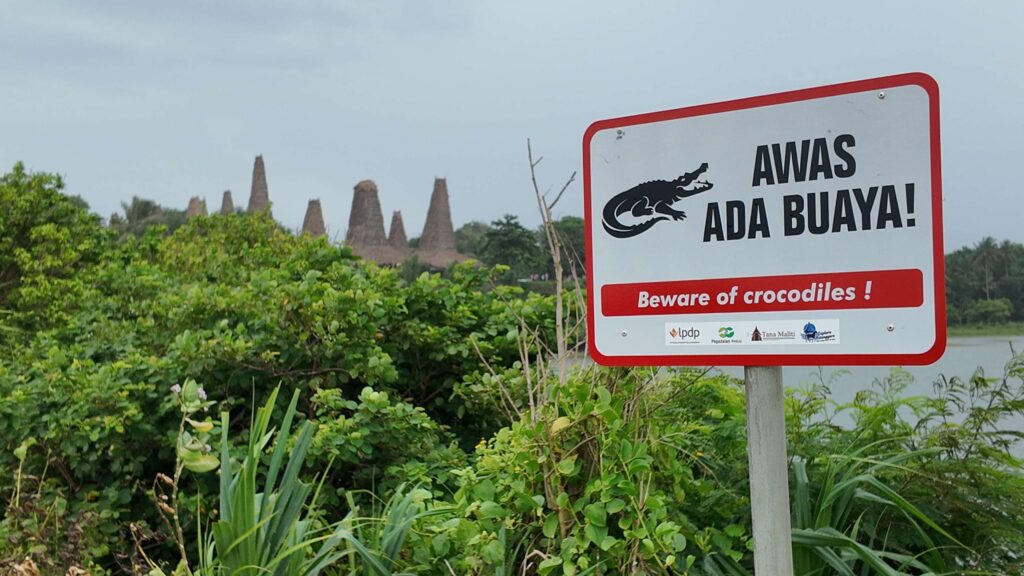
So within a few minutes on foot, you go from a traditional village to a spectacular beach, then to the meadow where the Pasola takes place.
It’s within this very particular triangle — the beauty of the landscape, the tradition of the village, and the action of the ritual — that one of the most fascinating and singular cultural events in Sumba unfolds.
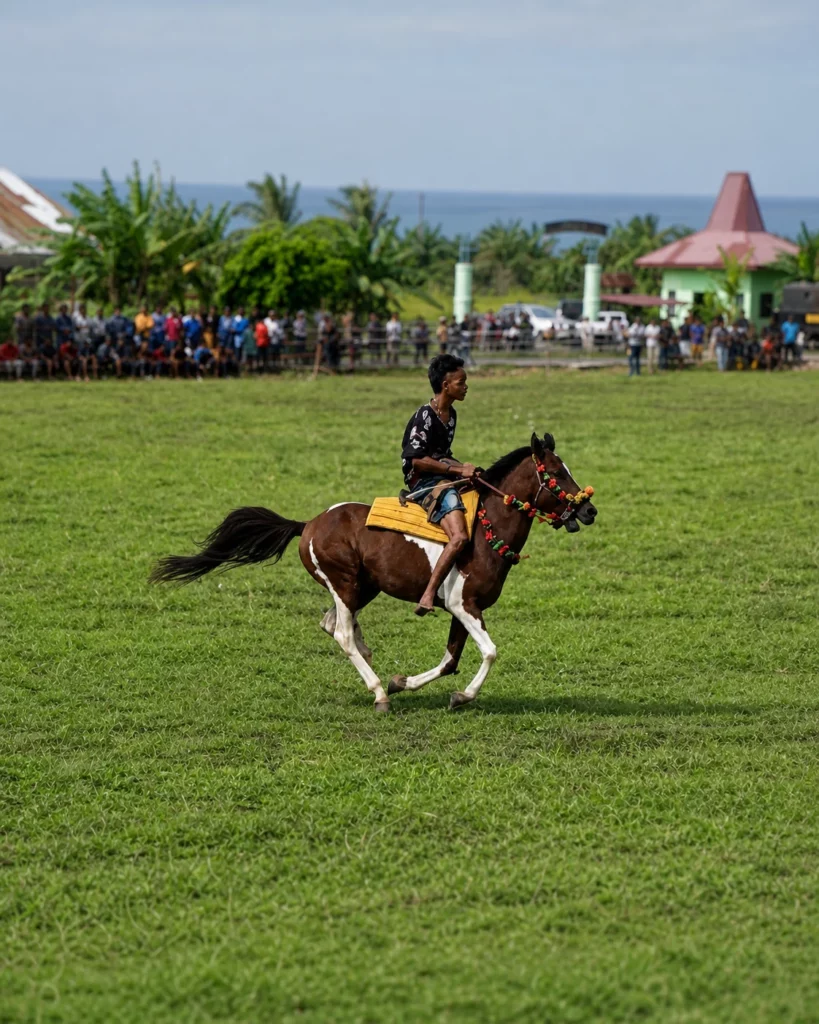
A meadow turned arena
The Pasola site is a flat, grassy meadow, located right next to the village and the coast.
The size of the field is roughly that of a village football pitch.
Contrary to what you might imagine, there’s no real physical barrier. In places, a simple string symbolically marks the boundary, but the separation is mostly visual.
The crowd naturally forms a circle around the space reserved for the horsemen.
A few organizers and police officers keep watch, but the setup stays simple.
When I arrive around 9 a.m., there’s already a crowd.
Most people came by scooter, parked a bit further away in an improvised space. A few small stalls sell snacks, but there’s no particular tourist infrastructure.
I notice one thing immediately: there are very few tourists.
That day, I counted barely five.
The atmosphere is striking: both festive and highly focused.
No amplified music, no speakers, no big sound system. Just conversations, shouts, and the crowd’s excitement.
You can tell right away this isn’t an event packaged for tourists. The organization relies on habit, oral tradition, and a kind of collective understanding. No one sells tickets, no one guides visitors. You have to watch, ask, and figure it out for yourself.
The horsemen enter: first clashes
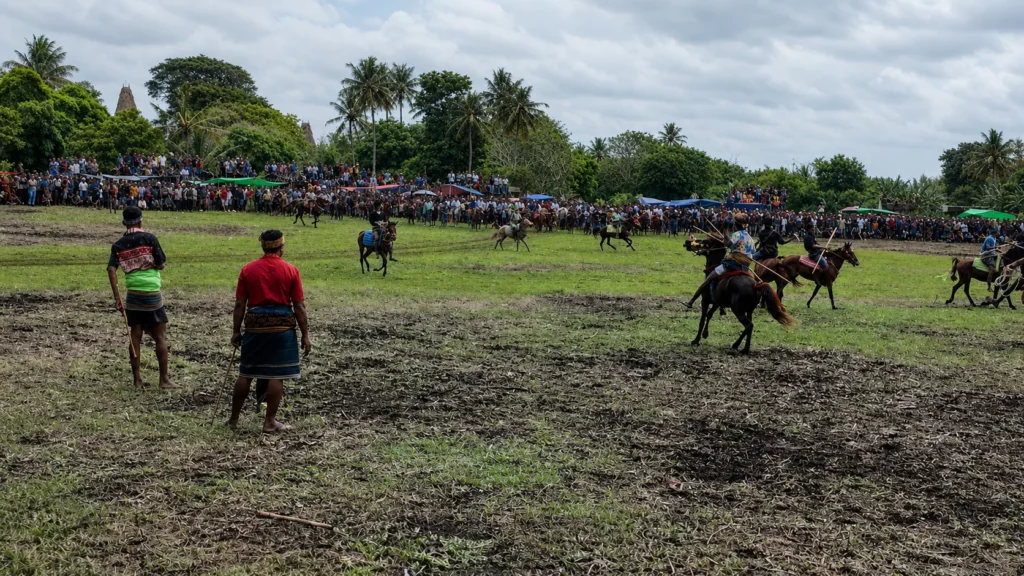
Around 9:30 a.m., the first activity starts.
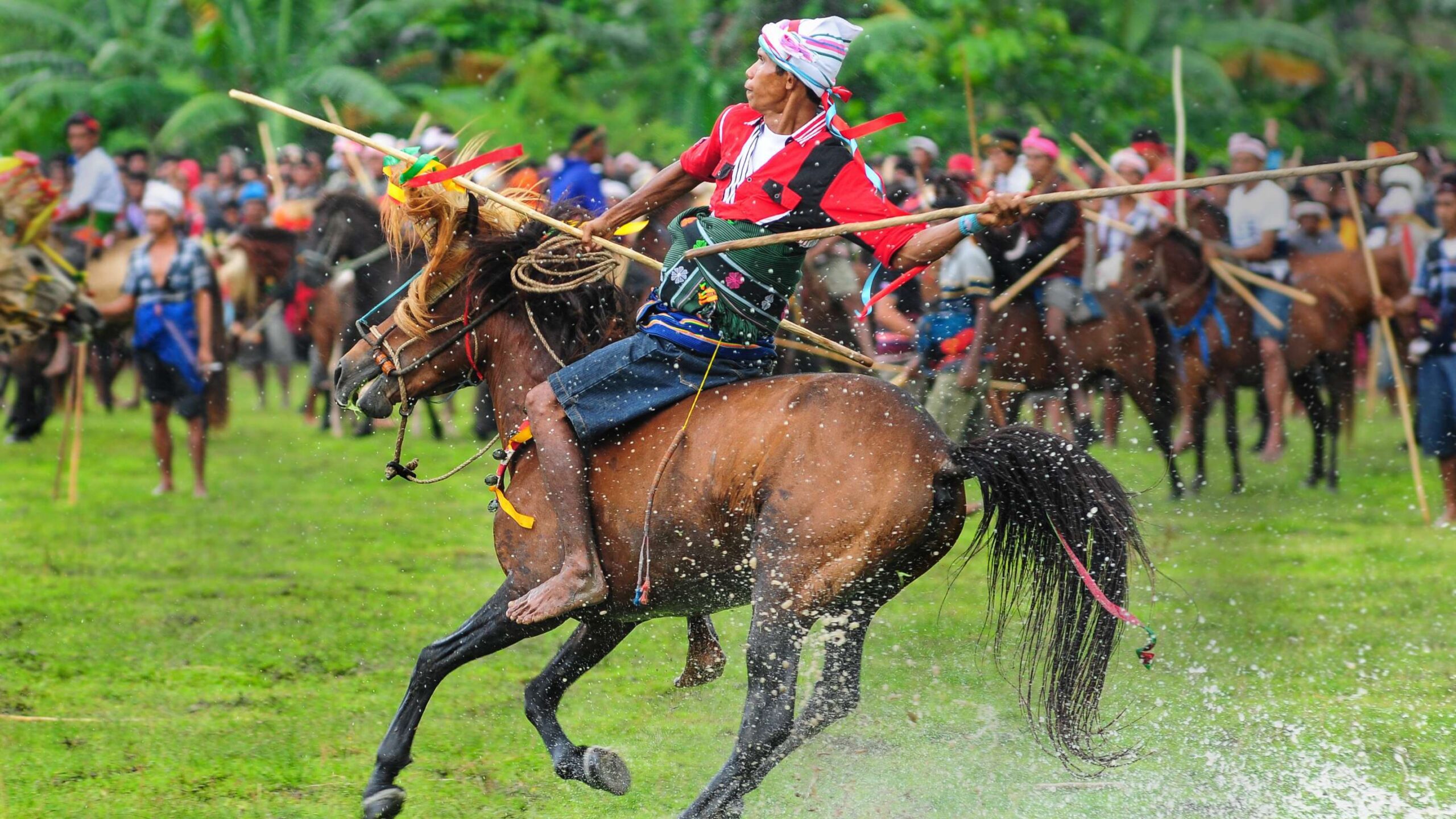
Horsemen enter the field for what looks like warm-ups, simply galloping from one end of the meadow to the other.
You also see gestures simulating spear throws, animated discussions, and instructions being exchanged between riders.
You quickly spot who seem to be the group leaders, by their attitude and the way they speak.
Then the entrances become more structured.
Groups of 5 to 10 horsemen gallop together. They shout, provoke, sometimes pretend to throw their spears without actually doing it.
These first passes feel almost like demonstrations or provocations.
Then, suddenly, the tension rises.
Two groups close in on each other, the horses speed up, and several riders throw their spears at the same time.
The charges are extremely fast.
The crowd reacts immediately: shouts, cheers, sometimes even little improvised dances.
The collective energy becomes very intense.
Very young, incredibly skilled horsemen
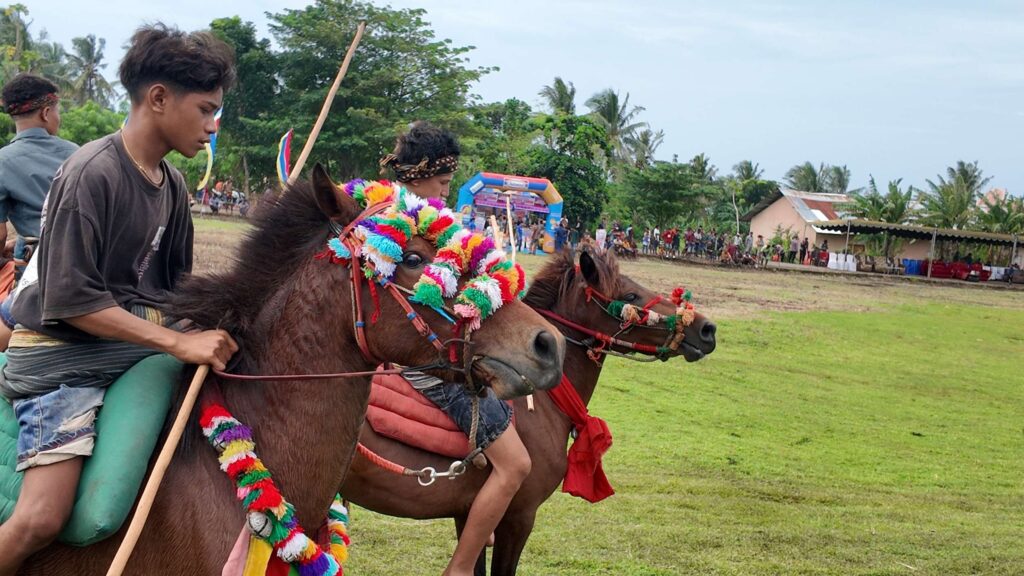
In total, I watched about 25 to 30 horsemen.
Many appear to be under thirty, some are even teenagers.
All of them ride with impressive confidence, proof they learned very young.
The horses are of the local Sumba breed, fairly small to medium-sized but very fast and high-strung.
Most riders ride almost bareback, without saddle or stirrups.
They wear no protection at all: no helmet, no shield, no armor.
Some wear simply a t-shirt and shorts or trousers. Others are dressed in very colorful traditional outfits, sometimes with headdresses.
Each rider holds several spare spears in one hand and throws them one after another during the charges.
The spears are very simple: long pieces of wood about 1.5 to 1.8 meters long, with the bark stripped off.
The tips are generally blunted, even though some seem slightly sharpened.
When they fall to the ground, someone on foot runs to pick them up and hand them back to the riders.
Real tension… but never aggressive
What strikes you most is the atmosphere.
The tension is real, the clashes are genuine, but there’s nothing aggressive about them. It feels more like the excitement of a traditional sport.
The horsemen generally stay more than ten meters from the crowd during the charges.
Once their run is over, they sometimes come back very close to the spectators. At that point, you can touch the horses without any trouble.
Several riders fall during the charges.
But they almost always get up right away, often laughing or cheered on by the crowd.
I didn’t see any serious injuries.
The whole thing gives the impression of a serious celebration: focused, respectful, and joyful all at once.
A simple, warm atmosphere
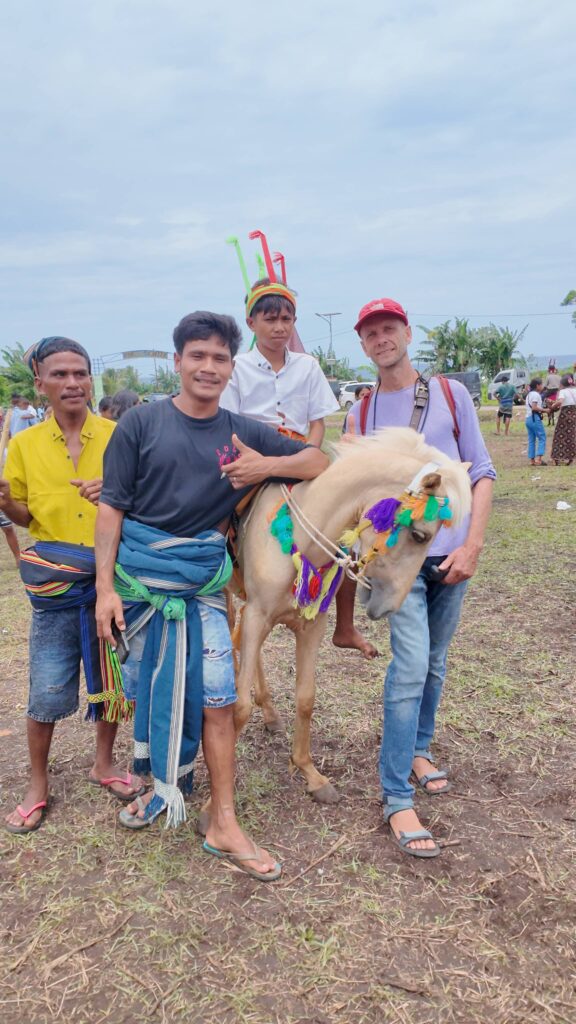
What also struck me a lot was the kindness and simplicity of the locals.
People easily come over to chat, offer to take a photo together, laugh or joke around.
You can feel a real warmth.
There’s no distance between visitors and locals. Everything happens naturally.
This simplicity makes the experience even more enjoyable.
The Pasola: a ritual tied to the Marapu tradition
To understand what you’re watching, you need to know that the Pasola isn’t just a show.
It’s an ancient ritual tied to Sumba’s traditional religion, called Marapu.
In this tradition, ancestors and spirits play a central role in the relationship between people, nature, and the fertility of the land.
The Pasola is historically tied to the seasonal appearance of sea worms called Nyale, which signal the right moment to hold the ritual.
In the past, the spears were genuinely sharp and the fights could be dangerous.
Blood shed during the Pasola was seen as a sign of fertility for the harvest.
Today, the spears are generally blunted and local authorities oversee the event more closely to limit accidents.
The presence of police officers and security units reflects that shift.
But the spirit of the ritual remains intact.
This shift between ancestral tradition and modern oversight creates an interesting tension. The Pasola stays a spiritual ritual for the locals, but it also has to work around safety, visitors, and a degree of modernization. This coexistence shows up everywhere: horsemen in traditional dress with smartphones, Marapu rituals watched over by police officers.
A Pasola that’s still very local and authentic
There are several Pasola events in Sumba, some drawing a lot of visitors.
The one I attended, near Ratenggaro, seemed much more local.
The crowd was made up almost entirely of people from the region.
The organization was simple, stalls were rare, and the atmosphere was very community-driven.
All of that reinforced the impression of witnessing a still-living tradition, rather than a show staged for tourists.
This authenticity reflects an approach to tourism I found again
elsewhere in Indonesia, particularly in the Lombok countryside.
➡️ Tetebatu (Lombok): Immersed in the Countryside at the Foot of Rinjani
A unique experience in a trip through Asia
This kind of experience is exactly what makes long trips through Asia so rich.
Beyond the landscapes and the itineraries, it’s often these local, unpredictable, authentic traditions that leave the deepest mark.
Because in the end, moments like this one aren’t always something you can plan.
But they’re often among the strongest memories.
Sumba: a still-wild island
Beyond the Pasola, Sumba hides spectacular landscapes: deserted beaches, turquoise lagoons, hidden waterfalls, traditional villages perched on hilltops.
The island remains one of the most unspoiled destinations in Indonesia.
Over two weeks in the west and center, I came across more
horses than tourists.
But Sumba is huge. Two weeks is just enough to
understand you’d need to come back.
That day, in Ratenggaro, I’d come for the Pasola.
Planning your trip to the Pasola
The Pasola takes place once a year, in February or March, depending
on the lunar calendar and the appearance of the nyale worms. The next one will be held in February-March 2027.
If you want to attend, I’ve prepared a complete practical guide with everything you need to know: how to follow the announcement
of the dates, which villages to prioritize, a detailed budget, and
logistics tips.
PRACTICAL GUIDEPasola Festival in Sumba: dates, villages and complete guide
In the meantime, you can subscribe to the newsletter to get
upcoming field reports and practical guides:
Leave a Reply