The idea was never to become a modern-day Robinson Crusoe.
Nor to abandon the world, nor to break away from everything.
I’m not looking for permanent isolation, still less a fixed way of living.
What I look for in an island isn’t isolation for its own sake.
It’s a pause.
A space between two cycles.
A way of breathing differently before returning to something that suits me better.
Living on an island, for me, isn’t settling there forever.
It’s spending a day, a week, a month there.
Just the time needed to feel that something is falling back into place.
Life is made of breaths.
Sometimes you need to step back a little in order to come back better.
➡️ On this topic, see the article: “Life moves forward in phases” (in French)
An island… or something like it
When I talk about an island, it isn’t necessarily some remote dot in the middle of nowhere.
It can be an inhabited island, a peninsula, a stretch of coast reachable on foot, a quiet shoreline…
or even a mountain village, a remote hamlet.
An island, deep down, is a place that detaches you from the noise and reconnects you to something simpler.
What I’m looking for isn’t the island itself:
it’s a way of becoming present again.
Robinson Crusoe, illusions, and reality
Robinson Crusoe created a lot of illusions in our collective imagination.
The idea that an island means total freedom, natural abundance, almost naked under the coconut trees.
In reality, an island can become demanding very quickly.
Weather, food, shelter, water, getting around… everything takes energy.
But at another stage, a truly deserted island can make sense.
Not in a logic of extreme survival, but in a chosen and prepared setting:
you stay a few days, you bring what’s necessary, you cover the essentials, and you explore a real form of self-reliance, without trying to play the hero.
It’s a pause. Not a break.
An intense experience, but an accessible one.
Because deep down, if you have to spend twelve hours a day just to survive, you haven’t simplified your life:
you’ve simply moved it somewhere else.
What I’m looking for is simplicity, not exhaustion.
Finding the right place: intuition and common sense
Choosing an island — or almost an island — takes clear-headedness.
In Southeast Asia, there’s always, at any time of year, a place with favorable weather… as long as you accept a minimum of mobility.
I look at simple criteria:
- accessible food: local markets, ripe fruit, coconuts, fish, shellfish
- the possibility of making a fire: dry wood, a sheltered spot, or at least a small stove
- a workable location: no cliffs, no hostile jungle, no dangerous tides
- minimal shelter: a shady spot, a rock overhang, a tarp if needed
- natural calm: a place peaceful enough that you can feel yourself settle
When you look at things concretely, you quickly realize you can’t do this just anywhere.
Otherwise, it becomes an ordeal, or survival in disguise.
The goal here is to create a space to recharge.
Not to exhaust yourself.
The island as a lesson
What I discovered in these places wasn’t just a setting: it was a rhythm.
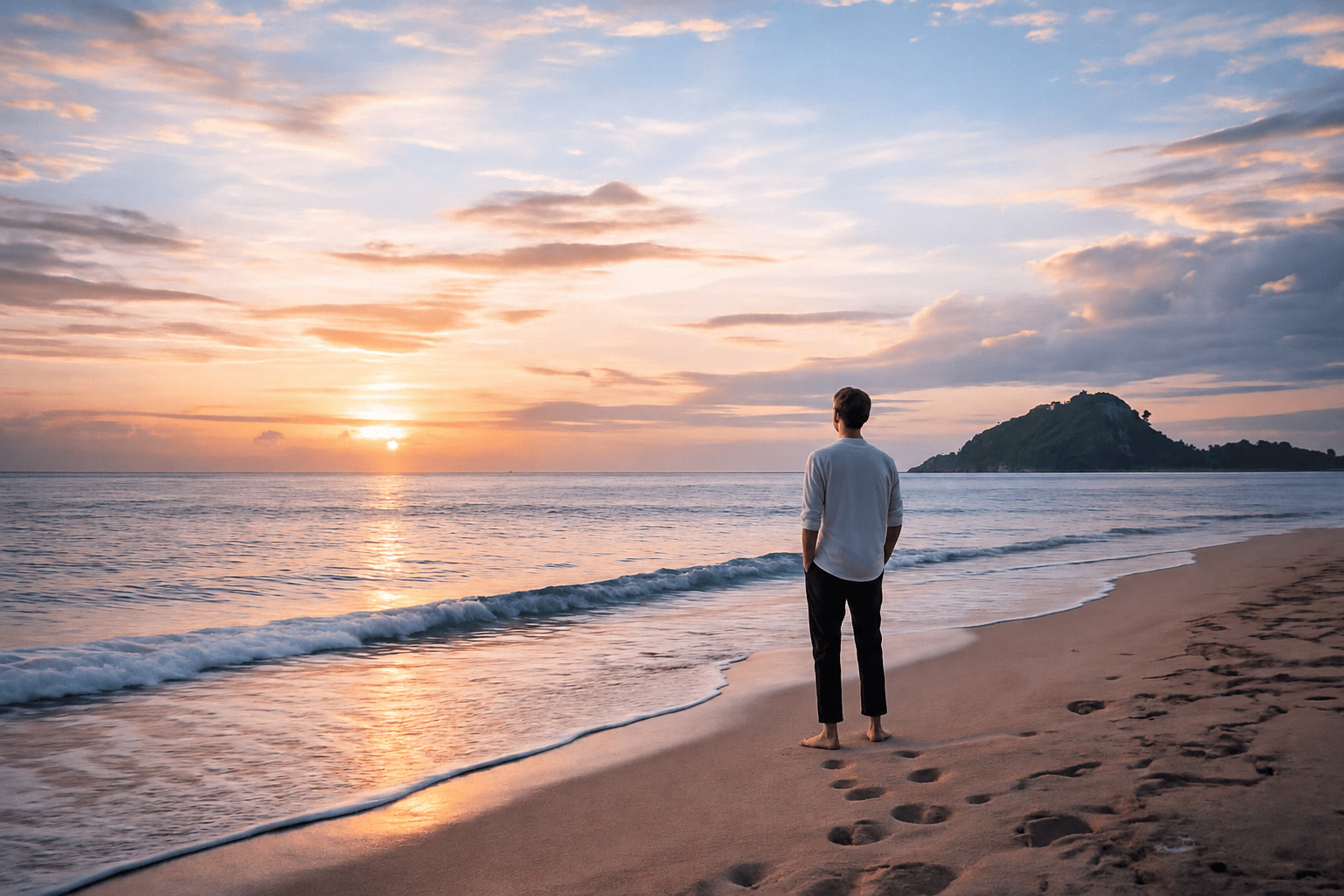
A quiet morning on a deserted beach.
The soft sound of the waves.
A first bit of foraging by the shore, simple but enough.
A fire lit without pressure, just for the pleasure of preparing something yourself.
Time slowing down, without freezing.
And then, the welcome I found in Indonesia.
Simple smiles, a presence without calculation, a human warmth without insistence.
A way of connecting with others effortlessly.
It’s one of the rarest luxuries there is.
Why “or almost” changes everything
An isolated island is beautiful… but it can quickly become a trap.
You go in circles, you depend on very little, you lose flexibility.
A peninsula or a stretch of coast, on the other hand, offers balance.
You can stay, move, adjust to the climate, follow your own rhythm.
And above all, you can return to solid ground if your body tires… or if boredom sets in.
Because an island, however beautiful, can start to feel narrow if you stay too long.
The goal isn’t to lock yourself away.
The goal is to breathe.
What I’ve understood
Living on an island… or almost, isn’t a permanent project.
It isn’t an identity.
It isn’t a break.
It’s a passage.
A way of recalibrating your life.
A space where you strip away the superfluous to see what’s left.
A step on my path toward independence, simplicity, and exploration.
It’s also one of the stages of my ➡️Six-Month Challenge, this project where, month after month, I explore different forms of independence and simplicity
This way of living isn’t an end goal.
It’s a tool.
A way of moving forward differently.
I also talk about it differently in:➡️ What Is True Luxury?
And you — what’s your island… or almost?
It doesn’t need to be surrounded by water.
It can be a place, a rhythm, a moment, a pause.
What matters is what soothes you.
What re-centers you.
What gives you space inside.
Where is your little island of breathing space, today?
And why not go meet it, even if just for a day?
To go further
➡️ Understand my full vision: Another way to talk about autonomy (in French)
➡️ Discover how I choose my places: How I recognize a place of transition (in French)
➡️ See all the articles: Vision & Foundations (in French)
Leave a Reply